


By MES Dispatch Staff
The Briefing
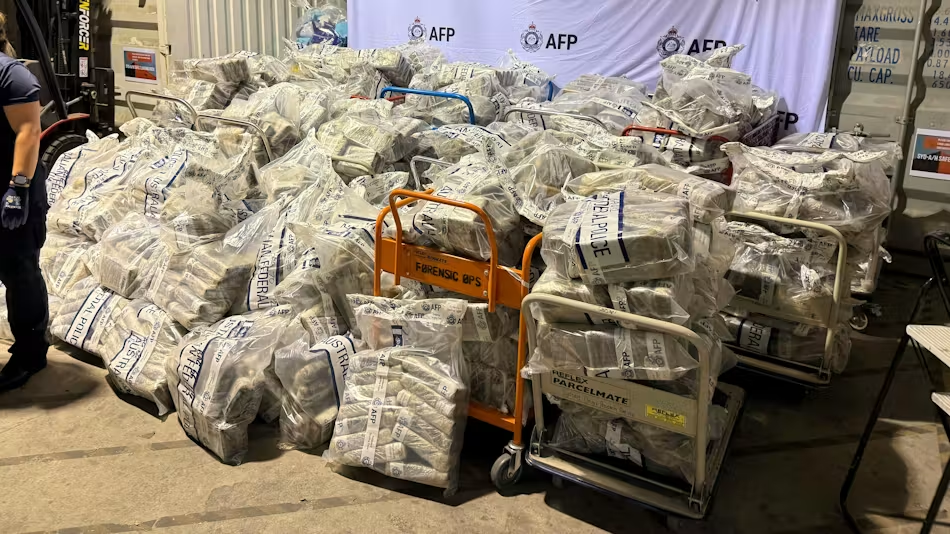
- Australian Federal Police and state law enforcement agencies seized approximately 2.7 tons of cocaine hidden in underground bunkers beneath shipping containers in Londonderry, near Sydney, on June 19—the largest cocaine seizure in the country’s history.
- Two men, aged 21 and 25, were arrested and charged with possessing a commercial quantity of an unlawfully imported border-controlled drug, a charge carrying a maximum life sentence under Australian law.
- The cocaine, valued at approximately 816 million Australian dollars (US $560 million), represents roughly three million individual street-level drug transactions, according to law enforcement estimates.
- Operation Minjiang began in May after Queensland police discovered a burned-out truck near Midge Point in North Queensland and recovered 40 kilograms of cocaine from nearby waters.
- Investigators allege the drugs were imported near Midge Point and transported to Sydney on behalf of an organized crime group operating along Australia’s east coast.
SYDNEY, AUSTRALIA — Australian law enforcement authorities executed a search warrant on June 19 at a semi-rural property in Londonderry, near western Sydney, and recovered approximately 2.7 tons of cocaine concealed in plastic tubs buried inside underground bunkers beneath false floors in three shipping containers, according to the Queensland Joint Organised Crime Taskforce (QJOCTF).
The seizure, part of Operation Minjiang, represents the largest cocaine seizure in Australian history and disrupts what authorities characterize as a sophisticated organized crime operation responsible for importing and distributing large quantities of narcotics along the country’s east coast. The cocaine has a street value of approximately 816 million Australian dollars, representing about three million individual street-level transactions.
A 21-year-old man from Plumpton and a 25-year-old man from Liverpool were arrested at the property. Investigators allege both men attempted to flee on foot before being apprehended. Both were charged with possessing a commercial quantity of an unlawfully imported border-controlled drug under Section 307.5 of the Criminal Code, an offense carrying a maximum penalty of life imprisonment. The men appeared before a New South Wales Local Court on June 20 and were remanded in custody pending trial.
The investigation began in May when Queensland Police Service officers responded to reports of a burned-out flatbed truck near Midge Point in North Queensland. Investigators recovered 40 kilograms of cocaine in nearby waters and subsequently identified a 41-year-old Mackay man as the truck’s owner. A series of search warrants across north and southeast Queensland and Sydney led to the June 19 discovery of the larger cache. Prior to the Londonderry seizure, investigators had recovered 178 kilograms of cocaine and 142 kilograms of methamphetamine during earlier phases of the operation.
Investigators allege the cocaine was imported near Midge Point and transported to Sydney on behalf of an organized crime group. The alleged mother vessel linked to the importation scheme, MV Wealth, remains detained in the Solomon Islands as the investigation continues. Additional arrests have been made as the multi-agency investigation proceeds. A 32-year-old Petrie man was charged with attempting to possess a commercial quantity of a border-controlled drug and will appear before Brisbane Magistrates Court on July 31. A 32-year-old Petrie woman was charged with the same offense and is also scheduled to appear July 31. A 24-year-old New South Wales man was charged and extradited to Queensland on June 19 and is expected to appear before Brisbane Magistrates Court on September 18.
The operation involved personnel from the Australian Federal Police, Queensland Police Service, Australian Border Force, Australian Criminal Intelligence Commission, Australian Transaction Reports and Analysis Centre, Australian Taxation Office, and New South Wales Police Force Highway Patrol. AFP Commander Stephen Jay characterized the investigation as demonstrating the sophistication and determination of modern transnational drug trafficking networks, while Queensland Police Acting Chief Superintendent Troy Pukallus emphasized the effectiveness of coordinated multi-agency investigations in disrupting organized crime.