


By MES Dispatch Staff
The Briefing
- Chief U.S. District Judge Eric Tostrud dismissed a Justice Department lawsuit July 21 that challenged Minnesota’s laws prohibiting local law enforcement from assisting U.S. Immigration and Customs Enforcement agents.
- The judge ruled that Minnesota’s statutes do not violate the Anticommandeering Doctrine under the 10th Amendment, which prohibits the federal government from compelling states to carry out federal directives.
- The disputed policies include a prohibition on sharing driver’s license information with ICE agents and ordinances limiting what data state and local police can share with federal immigration officers.
- The Trump administration lawsuit, filed in September 2025, preceded Operation Metro Surge, an ICE enforcement initiative that deployed approximately 4,000 agents to Minnesota.
- Similar lawsuits filed against sanctuary jurisdictions in Los Angeles, Illinois, New Jersey, and New York have been dismissed by federal courts; Maryland was among the latest to face DOJ legal action.
MINNEAPOLIS, MINN. — A federal judge rejected a Justice Department lawsuit challenging Minnesota’s immigration policies, ruling in a 56-page order that state and local laws regulating law enforcement procedures do not intrude on federal authority to enforce immigration law.
Chief U.S. District Judge Eric Tostrud dismissed the lawsuit, stating that Minnesota’s policies “do not command the federal government or its contractors to act. They do not forbid the federal government or its contractors from acting. They do not control how the federal government or its contractors undertake their work. Rather, they regulate how state and local officials perform their duties.”
The Trump administration filed suit in September 2025 seeking judicial declarations that Minnesota’s immigration statutes were unconstitutional and requesting prohibition of state enforcement. The lawsuit challenged laws prohibiting the sharing of driver’s license information with federal immigration agents and ordinances limiting what information local police can provide to ICE personnel.
State and municipal defendants included Minnesota, Minneapolis, St. Paul, and Hennepin County. Legal counsel representing the state argued that Minnesota was not impeding immigration law enforcement but declining to assist in enforcement of civil immigration statutes.
Tostrud determined that compelling Minnesota or its cities to participate in federal civil immigration enforcement would violate the Anticommandeering Doctrine of the 10th Amendment, which prevents federal government commandeering of state resources and personnel. The judge also noted that forcing states to assist in federal immigration efforts could create budgetary concerns by diverting state resources to enforce federal law.
The federal government asserted that Minnesota’s immigration laws unfairly targeted federal agents. Tostrud rejected that claim, finding that Minnesota’s restrictions apply equally to private companies and state agencies in addition to federal immigration personnel.
Minnesota Attorney General Keith Ellison characterized the ruling as reaffirming constitutional principles. “The Trump Administration, however, has no regard for this constitutional principle, so it nonetheless filed this lawsuit as part of its ongoing war against the people of Minnesota and its efforts to intimidate us into submission,” Ellison stated.
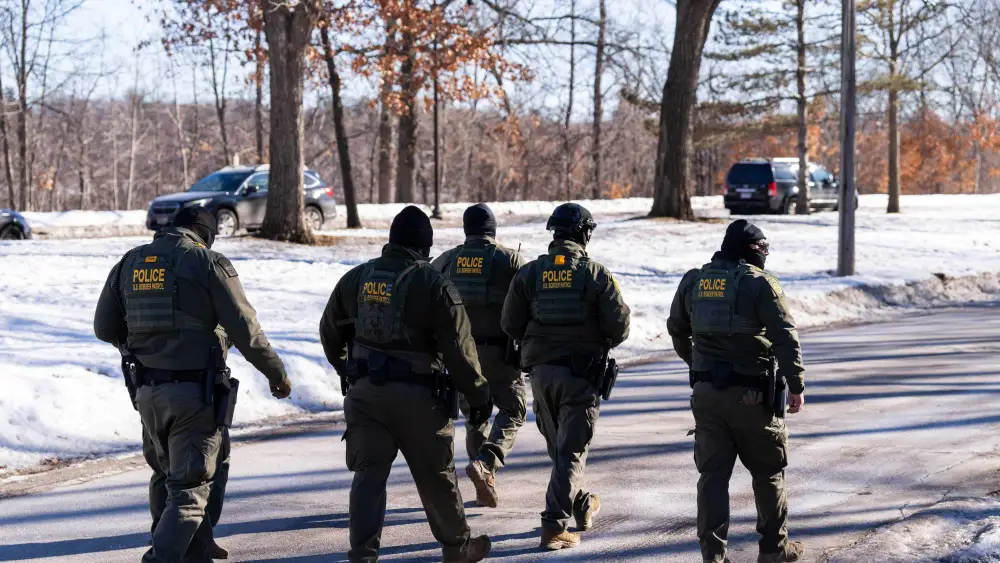
The Justice Department lawsuit preceded Operation Metro Surge, an ICE immigration enforcement operation that deployed approximately 4,000 federal agents to Minnesota. The Trump administration designated Minnesota among a dozen states as a “sanctuary jurisdiction” after the president issued an executive order identifying jurisdictions resisting federal immigration enforcement.
Federal courts in multiple jurisdictions have issued similar dismissals of DOJ lawsuits challenging sanctuary policies. Los Angeles, Illinois, New Jersey, and New York courts have each rejected comparable Justice Department legal challenges. Maryland recently faced a Justice Department lawsuit over its immigration laws.