


By MES Dispatch Staff
The Briefing
- The Los Angeles Police Department announced installation of Rumbler low-frequency siren systems on patrol vehicles to address declining driver response to traditional emergency sirens in an increasingly soundproofed vehicle environment.
- Twenty vehicles currently are equipped with the Rumbler system, with an additional 100 vehicles scheduled for installation; LAPD plans to equip approximately 2,000 of its 5,000 vehicles within the next two years.
- The Rumbler system utilizes 10-inch speakers to amplify low-frequency tones that penetrate vehicle materials, complementing traditional sirens rated at 110 to 120 decibels; the device also plays prerecorded directional messages in English and Spanish.
- Modern vehicles employ noise-dampening technology and acoustic insulation that reduce road noise but inadvertently shield drivers from traditional siren frequencies, prompting LAPD to adopt the technology.
- The New York Police Department first deployed Rumbler systems in 2009 on approximately 150 vehicles before expanding to 500 units; community advocates have raised concerns about noise pollution impacts in residential neighborhoods.
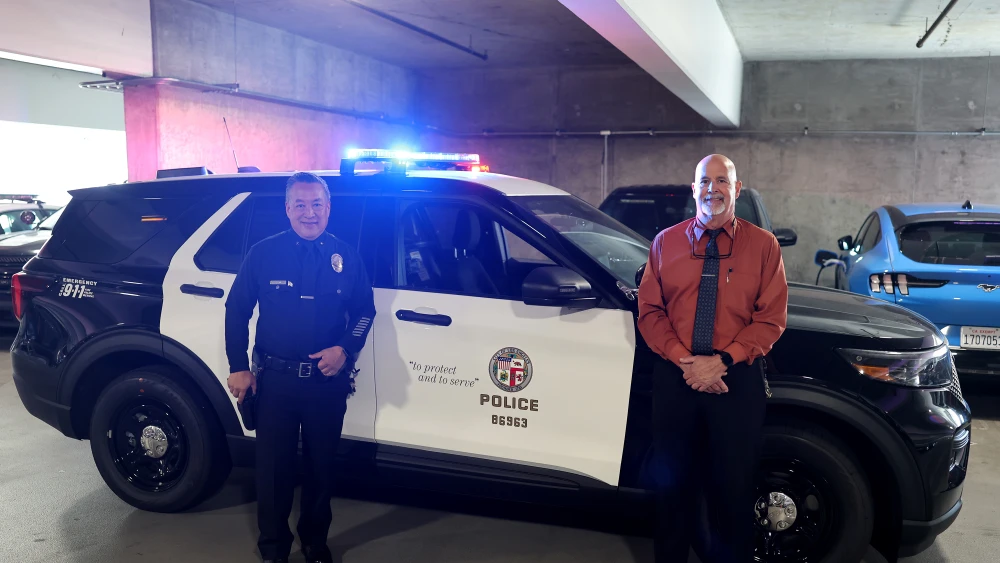
LOS ANGELES, CALIF. — The Los Angeles Police Department has installed low-frequency siren technology on patrol vehicles to address driver inattention to traditional emergency sirens, citing concerns that modern vehicles’ sound insulation prevents drivers from hearing auditory warnings during emergency response.
Police Commander Blake Chow, a 36-year veteran and head of the LAPD Support Services Group, stated that officers frequently report incidents in which drivers fail to yield to emergency vehicles despite audible sirens. Chow stated that multiple vehicles may pass through intersections before traffic stops, creating hazardous conditions for emergency personnel and pedestrians.
“We had to find a way to get these drivers’ attention,” Chow stated.
The Rumbler is manufactured by Federal Signal, an Illinois-based company specializing in emergency alert systems. The system consists of two subwoofers, an amplifier, and a timing module, with equipment costs ranging from $600 to $1,000 per unit depending on accessories.
The Rumbler generates low-frequency tones designed to penetrate solid materials, allowing vehicle operators and pedestrians to perceive the siren through tactile sensations in addition to auditory reception. The system operates in eight-second intervals and emits prerecorded directional messages in English and Spanish, such as “Move to the right,” eliminating the requirement for officers to verbally direct traffic.
Modern vehicle designs incorporate multiple noise-reduction technologies that inadvertently shield drivers from traditional emergency sirens. Contemporary vehicles employ active road noise cancellation technology, silicone-based door seals that eliminate high-frequency whistling, and noise-dampening window designs. High-end vehicles such as the BMW X7, Volvo X90, and Lexus TX 350 register interior noise levels below 50 decibels, equivalent to background noise from household appliances. Mid-range vehicles such as the Kia K5 and Hyundai Sonata N-Line similarly achieve interior noise levels around 51 to 52 decibels.
By comparison, traditional police sirens operate at 110 to 120 decibels, but these frequencies may bounce off vehicles and buildings rather than penetrating interior spaces.
The LAPD has installed Rumbler systems on 20 vehicles, with an additional 100 units scheduled for deployment. Police Director of Motor Transportation Greg Field stated that downtown Los Angeles’ Civic Center area will receive the first full deployments. Field, a 27-year LAPD veteran, anticipates deployment to approximately 2,000 of the department’s 5,000 vehicles within the next two years.
The installation includes a sound and light synchronization system that coordinates multiple vehicles’ emergency broadcasts while synchronizing flashing light patterns. Police officials stated the synchronized announcement capability proves useful for mass communication during fire evacuations and unlawful assembly situations.
Field stated that technology enhancements required no additional departmental funding due to vendor agreements permitting installation at no cost.
The Rumbler technology is not new. The New York Police Department first deployed the system in 2009 on approximately 150 vehicles before expanding to 500 units by the following year. Long Beach Police Department similarly adopted the Rumbler in 2009 but transitioned to the Howler system in 2023, with a department spokesperson stating officer feedback indicated the Howler proved more effective than traditional sirens at capturing driver attention.
Community advocates have raised concerns regarding the Rumbler’s impact on residential neighborhoods and quality of life. Richard Tur, founder of NoiseOff, an organization tracking noise pollution solutions, stated that residents experience the low-frequency siren as an “acoustic assault.” Tur noted that New York residents living near police stations report the Rumbler’s repeated use for department entry and exit operations creates ongoing noise disturbance.
Hamid Khan, an organizer with the Stop LAPD Spying Coalition, expressed concern that expanded Rumbler deployment may disproportionately affect lower-income neighborhoods. Khan referenced a 2023 audit documenting that LAPD helicopter usage—another enforcement-related noise source—concentrated most non-priority calls in communities such as South Los Angeles. Khan stated that additional noise exposure affects sleep cycles, hearing acuity, and resident well-being.