


April 14, 2023 Police departments around the world learned from the tragedy of the 2013 Boston Marathon bombing when it comes to how they could better prepare for and protect large-scale events.
By Will Katcher Source masslive.com Distributed by Tribune Content Agency, LLC.
Edward Davis, the former Boston Police commissioner, was in London after the July 2005 bombings of the city’s public transit system when he received a valuable piece of advice from Sir Ian Blair, then the commissioner of London’s Metropolitan Police Service.
“He said, ‘We never would have solved this case if it wasn’t for video, so the single most important thing you can do is get video in the hands of the investigators as soon as possible,’” Davis said.
Years later, that advice would prove essential.
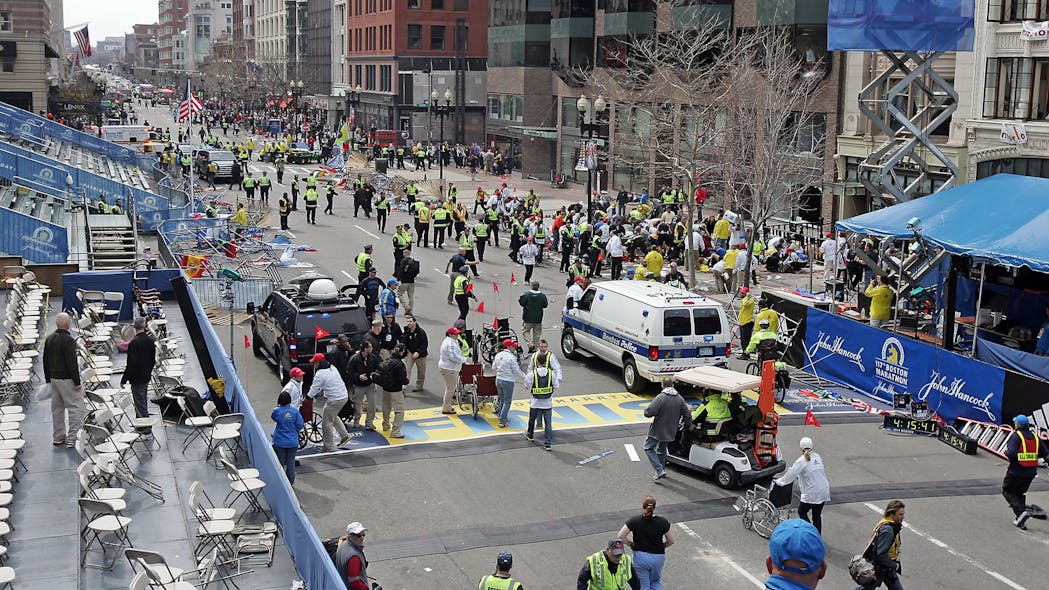
It was the afternoon of April 15, 2013, and Davis stood on Boylston Street, where two explosives had ripped through the finish line corridor of the Boston Marathon.
One of the first things Davis did, he recalled, was assign detectives to track down security footage from nearby surveillance cameras.
Davis said he later called Blair to offer thanks. The abundance of images investigators accumulated helped them to identify a pair of suspects, who on Marathon Monday had strolled through the throngs of race spectators with backpacks draped over their shoulders, deposited the bags in the crowd and walked away before they exploded.
Police departments are constantly learning from themselves and each other. Just as Davis took note of how London police swiftly identified their bombing suspects, police in Massachusetts and across the world learned from the tragedy of the Boston Marathon how they could better prepare for and protect large-scale events and respond to moments of crisis.
“We’re a world of copycats,” said Chief James Hicks, of the Natick Police Department, in an interview.
A 130-page “after action report” by local and state officials on the marathon response, one of the multiple reports to examine how authorities handled the bombings, found that “overall, the response to the Boston Marathon bombings must be considered a great success.”
Every person injured by the bombs and brought to a hospital survived, the After Action Report for the Response to the 2013 Boston Marathon Bombings noted. Throughout the week following, police agencies worked well together, the report said. Five days after the attack, with one suspect dead and the other in custody, Greater Boston breathed a sigh of relief.
But there were lessons to learn, too, that made future marathons the safest they had ever been, officials said, and set an international model for protecting an event of immense scale.
‘Everyone is in the room’
Perhaps the most significant lesson, according to local police officials, was the importance of cooperation between the different departments and public safety agencies who protect the race and investigated its attack.
After the bombing, “there were no egos,” Davis said. “Everyone pulled in the same direction.”
Marathon planning is a months-long process led by the Boston Athletic Association — the race’s host — and the Massachusetts Emergency Management Agency, or MEMA. Protecting the event involves dozens of departments and agencies, from local police, fire and public works departments, to the FBI and National Guard.
It is an immensely difficult competition to police, compared to other sporting events, concerts or large gatherings.
The 26.2-mile race course — most of which is open to the public — cuts through eight towns and cities, rather than looping solely through Boston. The race effectively cuts these communities in half, meaning police must plan carefully to ensure they can still reach anywhere in town if an emergency arises on Marathon Monday.
The 2013 marathon was Hicks’ third after he became Natick’s police chief in 2011.
In the two years prior, Hicks said he did not recall sitting in marathon planning meetings with FBI explosives experts or representatives from the Army.
“But now when we have the discussions everyone is in the room. Everyone. And everyone along the route has a say,” he said.
Together, they prepare for everything from weather catastrophes to far more sinister possibilities.
“The discussions that take place now, the planning,” Hicks said, “was definitely improved after 2013.”
On race day, representatives from each of the departments involved in marathon planning and safety will be at a command center at MEMA headquarters in Framingham. Other command centers dot the race course.
That way, “if a decision has to be made we have all the people together,” said Det. Sgt. Scott van Raalten, of the Hopkinton Police, who will represent his department at a central command post.
The after action report commissioned by local and state leaders found that the existing rapport between key officials helped significantly in the moments and days after the bombing.
“My favorite saying is ‘you can’t develop a relationship during a crisis,’” Davis said. Between him, the lead FBI officials in Boston, the Massachusetts State Police brass and other police officials, “there was a deep personal trust before this incident happened.”
Global lessons
Across the world, police departments took note of how their Boston-area counterparts responded to the bombing.
Hopkinton Police Chief Joseph Bennett said organizers for the Olympic Games in Rio de Janeiro and Tokyo came to Massachusetts to study the safety plan developed for the Boston Marathon in the years following the attack, which he called “the gold standard.”
Davis said he lectured at a Singapore police academy, where one police official mentioned never considering that people would have dropped backpacks or other bags as they fled the explosions at the marathon finish line. Each of those bags had to be checked for explosives.
After the marathon bombing, platforms such as Facebook and Twitter became essential tools for police.
“For the very first time in a terrorist attack, law enforcement relied on social media as a means of getting information out, but also a means of getting information in,” Davis said.
Other police took notice. Davis said the New York Police Department sent representatives to Boston to learn how officials had used social media after the attack.
The marathon bombing also provided an important lesson for Massachusetts leaders as they enlisted social media to relay information to a fearful public. The after action report by local and state leaders found that some posts from different public safety organizations were “erroneous and in contrast to one another.”
The lesson: in times of crisis, leaders needed to coordinate their messaging.
Always learning
Chief Inspector Michael Cram, the special operations bureau chief for the Philadelphia Police Department, said his department takes lessons from incidents at crowded events across the world — from the Boston bombing to the fatal crowd crush at a Travis Scott concert in Houston in 2021.
In recent weeks, he’s examined how police in France and Israel have handled mass protests in their own countries.
“It’s a constant process,” Cram said. “I look at things happening all over the world. If it’s crowd related and centered on an event, I take a look at it.”
In 2018, after the Philadelphia Eagles defeated the New England Patriots in Super Bowl LII, Cram said jubilant Philadelphia residents overtook the city streets and sidewalks in celebration.
“People weren’t doing anything malicious, but things collapsed and people got hurt,” he said.
Philadelphia police learned from their own experience. In February, leading up to the Super Bowl LVII matchup between the Eagles and Kansas City Chiefs, police lined the downtown streets with bike racks. By ceding the street to the masses, Cram said the crowds stayed contained and police could move easily up and down the sidewalks.
“If you were to go across the country and talk to anyone planning events, we’re always looking at things going on in other places and learning,” Cram said.
‘The volume of work is so much more’
On the day of the marathon attack, as she ran past Boston College, toward a sweeping downhill that would take her through Cleveland Circle, onto Beacon Street and into the final miles of the race, Casey Hatchett could see it in the faces of the police officers she passed — something was wrong.
Hatchett, then a patrol officer for the Brookline Police Department, was 22 or so miles into the race. Via text, she learned of an explosion at the Marathon finish line. Then she learned of another. And then, under the burden of so many simultaneous calls, the cell service cut out.
Hatchett ran not quite a mile back to her home in Washington Square, a straight shot down Beacon. And then she went in to work helping stranded runners find shelter.
Now a Brookline police lieutenant, Hatchett said race organizers learned from the bombing that even in the event of a disaster, “runners will continue to run.”
She had the benefit of living less than a mile away when tragedy struck in 2013. Many other Boston Marathon athletes, competing in one of the world’s largest marathons, come from across the globe. After the bombing, many were left unable to access their belongings or lodging.
Each community along the race course now has reception centers open and ready to provide shelter to athletes in case of emergency, Hatchett said. There are buses ready to transport athletes to Boston, where their belongings are stored, in case the race is called off.
There were other issues with the marathon response identified in the after action report.
Many police officers did not have “appropriate weapons discipline” on the night they first encountered the two bombing suspects in Watertown, nor did they show restraint with their weapons after locating one suspect hiding in a boat, the report said.
In both cases, police gunfire “created dangerous crossfire situations.”
Officer Richard Donohue, of the MBTA Transit Police Department, was shot and critically injured during the initial gunfight with the bombing suspects in Watertown. An investigation by the Middlesex District Attorney’s Office found it was “highly likely” that he was shot by friendly fire from another police officer.
Officers and other public safety officials worked long shifts in the days and weeks following the bombings, compounding the stress of handling a traumatic incident with fatigue, the report also said.
“I was averaging three-to-four hours of sleep,” Davis said. Some of his officers slept less, if at all, on some nights.
“These are highly motivated people, detectives and special operations guys that don’t want to go home,” he said. “We learned they have to be ordered to go home.”
Other changes are woven into the fabric of race planning.
The police presence has increased. Hatchett said Brookline has probably doubled the number of officers working the marathon that it used to, with help from cities such as Cambridge and Quincy that don’t host sections of the race.
“There were years I didn’t work the marathon,” said Paul Campbell, deputy superintendent of the Brookline Police. “Those days are over. Everyone in the entire department is assigned to work the marathon.”
In an interview, Campbell joked that Tuesday was his favorite part of Marathon Monday.
Then he added: “There’s so much hard work and planning that goes into it. The volume of work is so much more than it used to be, but once Marathon Monday comes the day runs pretty smoothly. And my kidding aside, I love being out there. People are happy, cheering the runners on. Hopefully, we get a decent day weather-wise. It’s a fun day to be out there.”